
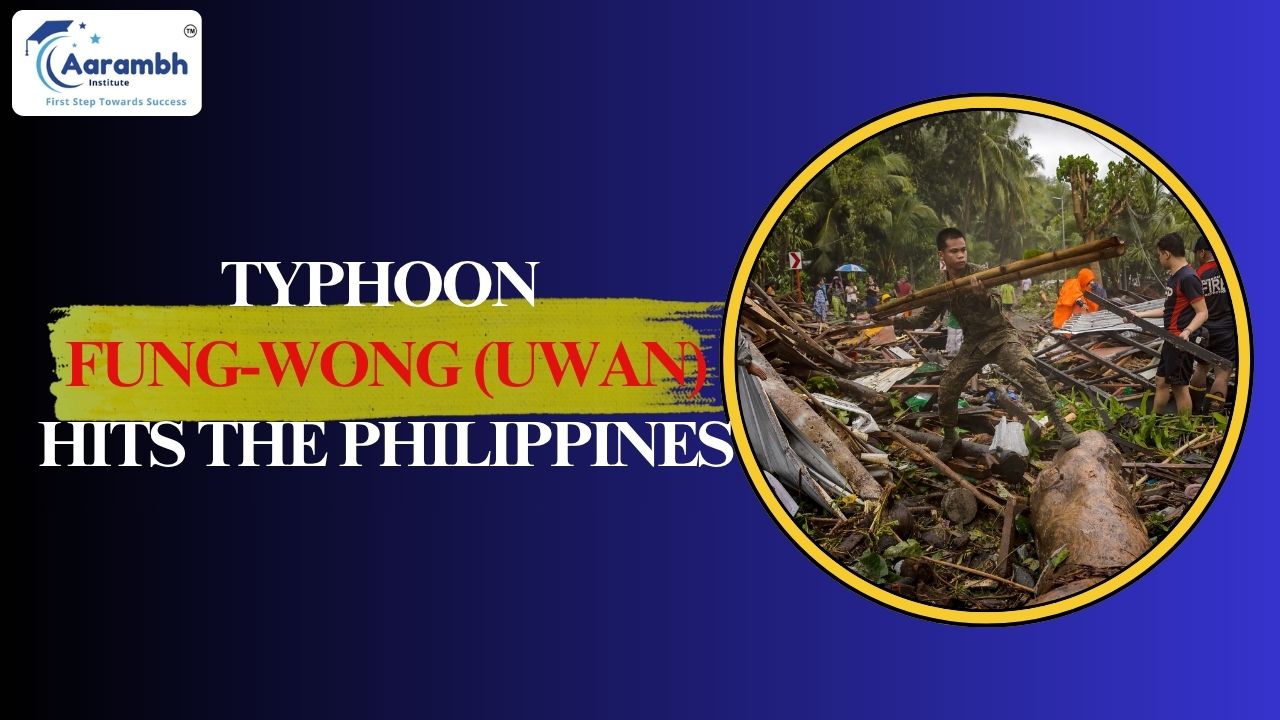

- Typhoon Fung-wong (local name: Uwan) made landfall in Aurora province, northern Luzon, Philippines, with sustained winds of 185 km/h and gusts up to 230 km/h.
- The typhoon caused heavy rainfall, flash floods, and widespread power outages across multiple provinces before weakening over La Union.
- It is one of the strongest storms to hit the country in 2025.
Geographical and Meteorological Aspects
- The Philippine Atmospheric, Geophysical and Astronomical Services Administration (PAGASA) confirmed that the typhoon rapidly intensified while approaching the eastern coast.
- The Philippines lies in the Pacific typhoon belt, making it one of the most disaster-prone regions in the world.
- An average of 20 tropical cyclones strike the country every year.
- The warming of ocean temperatures due to climate change has been linked to the increasing frequency and intensity of such storms.
Impact and Damages
- Heavy flooding and landslides occurred in Aurora, Nueva Ecija, and Benguet provinces.
- Strong winds uprooted trees, destroyed homes, and damaged power and communication lines.
- The National Disaster Risk Reduction and Management Council (NDRRMC) reported casualties and missing persons, though assessments are still ongoing.
- Thousands of residents were evacuated from coastal and low-lying areas as a precautionary measure.
- Flights, classes, and sea travel were suspended across Luzon to ensure public safety.
Relief and Response Measures
- The Philippine government launched emergency relief operations with assistance from the military and local authorities.
- President Ferdinand Marcos Jr. held an emergency meeting with the National Disaster Council to coordinate response actions.
- The Department of Social Welfare and Development (DSWD) provided emergency funds, relief goods, and aid to evacuation centers.
- PAGASA downgraded the system to a tropical storm as it moved northwest toward the West Philippine Sea but maintained warnings for flash floods and landslides.
Context – Back-to-Back Typhoon Events
- Typhoon Fung-wong struck just weeks after Typhoon Kalmaegi, which caused over 200 deaths and led to a state of calamity in several regions.
- The back-to-back disasters have highlighted the Philippines’ vulnerability and limited disaster recovery capacity.
- Experts warn that repeated cyclones could strain local resources, delay reconstruction, and increase the vulnerability of affected populations.
Environmental and Policy Relevance (UPSC Perspective)
- Demonstrates the link between climate change and extreme weather events.
- Emphasizes the importance of disaster risk reduction (DRR) and climate adaptation strategies.
- Highlights the need for regional cooperation in disaster management within the Asia-Pacific region.