
Overview of the CCPI 2026
- The Climate Change Performance Index (CCPI) 2026 has been released on the sidelines of the UN Climate Conference (COP30) in Belém, Brazil.
- The index evaluates the climate mitigation performance of 63 countries + the European Union, together responsible for over 90% of global GHG emissions.
- Countries are assessed across four categories:
- Greenhouse Gas (GHG) Emissions
- Renewable Energy
- Energy Use
- Climate Policy
- The top three ranks remain unoccupied, as no country is on track to meet global climate targets.
- Denmark (4th), UK (5th), Morocco (6th) are the top-performing countries.
India’s Rank and Performance in CCPI 2026
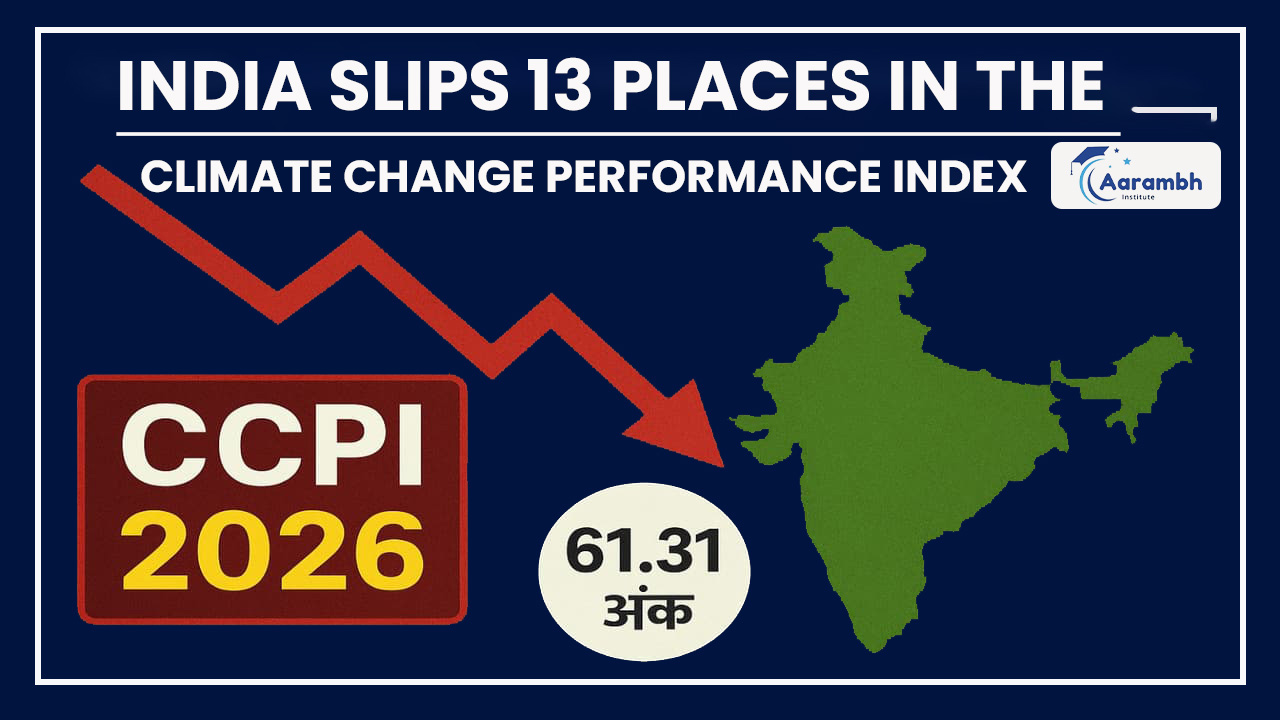
- India has dropped 13 positions, ranking 23rd in CCPI 2026—its steepest fall in recent years.
- India’s overall score is 61.31, placing the country in the “medium performance” category.
- India receives a medium rating in GHG emissions, energy use, and climate policy categories.
- India receives a low rating in the renewable energy category.
- India is listed among the world’s largest producers of coal, oil, and gas, highlighting a conflict between its development needs and climate goals.
Progress on Renewable Energy
- India has made significant progress in renewable energy expansion.
- Non-fossil sources now constitute more than 50% of its installed power capacity, achieved well before the 2030 target.
- Renewable energy’s share in the total energy mix has increased to around 14%.
- India has rapidly expanded solar power, including large-scale and rooftop installations.
Concerns: Dependence on Coal
- Despite progress in renewables, coal remains central to India’s energy strategy.
- India has no declared coal exit date.
- New coal blocks continue to be auctioned and coal production is planned to increase.
- The lack of a structured coal phase-down poses a major challenge for achieving climate commitments.
Key Concerns Highlighted for India
- The absence of a time-bound coal phase-out plan remains a critical weakness.
- India has weak carbon price signals and continued fossil fuel subsidies, which incentivize high-emission infrastructure.
- Large grid-scale renewable energy projects have caused environmental and social conflicts, particularly in ecologically sensitive regions.
Recommendations for India
- Introduce a clear coal phase-out strategy, including:
- A no-new-coal date
- A defined coal peak year
- Strengthen safeguards for renewable energy projects, ensuring minimal social and ecological disruption.
- Set binding sector-wise and state-level decarbonisation targets for 2035 and 2040.
- Ensure a just transition that protects workers, smallholders, women, and vulnerable communities affected by energy shifts.