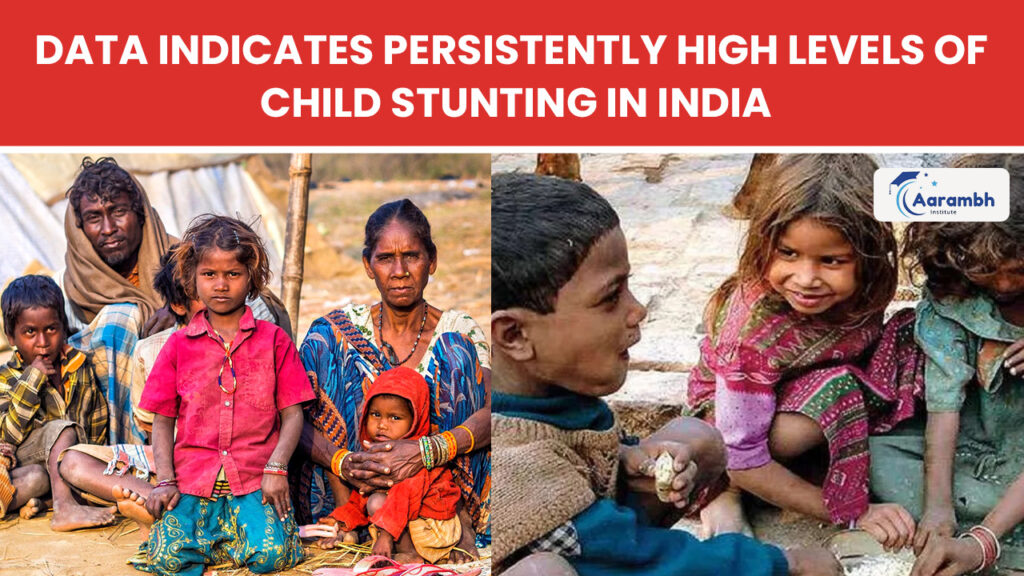
Recent government data shared in Parliament reveal that about one-third of children under five in India remain chronically undernourished, underscoring persistent structural challenges in child nutrition despite ongoing policy efforts.
Key Findings from the Latest Data
According to the most recent data collected under the Poshan Tracker (as shared in Parliament), more than 6.44 crore children (0–5 years) — enrolled in Anganwadi centres — have been assessed for height and weight. Of these, 33.54% were found to be stunted, 14.41% underweight, and 5.03% wasted.
These figures suggest that ~ 34 per cent of under-five children are stunted — a marker of chronic undernutrition and impaired growth.
Comparison with Earlier Large-scale Survey (NFHS-5)
According to the National Family Health Survey-5 (NFHS-5, 2019–21), national-level stunting stood at 35.5%, underweight at 32.1%, and wasting at 19.3% for children under five.
The new Poshan Tracker numbers appear marginally better for stunting (33.5% vs 35.5%), and considerably better for underweight/wasting compared to NFHS-5.
However, the decline — especially in wasting and underweight — is far steeper than stunting, indicating that improvements are uneven and that chronic forms of malnutrition remain deeply entrenched.
Understanding “Stunting” and Its Significance
“Stunting” refers to low height-for-age (below –2 standard deviations from the median of World Health Organization (WHO) growth standards), indicating long-term nutritional deprivation.
Stunting, especially in the first 2–5 years of life, can have long-term consequences — impaired cognitive development, reduced learning capacity, lower productivity, higher risk of adult diseases, and intergenerational transmission of poverty.
Policy Response: Consolidation & Monitoring
The government’s nutrition architecture has undergone restructuring under Mission Saksham Anganwadi and Poshan 2.0, integrating Anganwadi services and supplementation schemes to streamline service delivery.
The Poshan Tracker functions as a real-time monitoring tool to identify children who are stunted, wasted, or underweight, thereby enabling targeted interventions at the community level.
Critical Assessment & What the Data Does — and Does Not — Tell
Coverage limitation — Poshan Tracker data applies only to children enrolled in Anganwadi centres. The 6.44 crore figure does not represent all under-five children in India. Thus, the reported 33.54 % stunting reflects only a subset; actual national prevalence could differ.
Methodological difference vs. NFHS — NFHS is a scientifically representative household survey covering all regions and populations, whereas Anganwadi-based data may be biased, especially if enrolment or follow-up rates are uneven across states, rural/urban, caste/ class. Direct comparison must be cautious.
Decline in underweight/wasting sharper than stunting — suggests that while short-term nutrition and acute malnutrition (wasting) are being addressed, long-term, chronic deprivation (which leads to stunting) is harder to eliminate. Root causes — maternal nutrition, early childhood feeding practices, poverty, sanitation — tend to be structural.
Need for disaggregated data — National-level aggregates mask huge inter-state, rural-urban, socio-economic and caste-based disparities. For a policy-oriented analysis (especially in UPSC-style writing), it would be useful to have state-wise breakdown, rural vs urban split, and ideally data on socio-economic & caste/class cohorts. NFHS-5 provides such data.
Beyond anthropometry: dietary quality, micronutrients, maternal health — Stunting is not only about calories or weight, but also about diet diversity, micronutrient intake, prenatal and early childhood care, sanitation and disease burden. Various reports emphasise that tackling stunting requires multi-dimensional interventions: maternal health, infant feeding practices, hygiene, dietary diversity and social determinants.
Conclusion
The new Poshan Tracker data, showing ~ 34 % stunting among Anganwadi-enrolled under-five children, offers a cautiously optimistic sign of marginal improvement compared to NFHS-5 survey figures. However, the persistence of a high proportion of chronically malnourished children underscores deep-rooted structural challenges in early childhood nutrition, maternal health, socio-economic inequality, and the delivery of public health and nutrition services.
While consolidated programmes such as Poshan 2.0 and real-time tracking via Poshan Tracker provide better monitoring and targeted interventions, achieving substantial reduction in stunting will require sustained, multi-sectoral efforts — including maternal health, dietary diversity, sanitation, awareness generation, and targeted support for the most vulnerable populations.