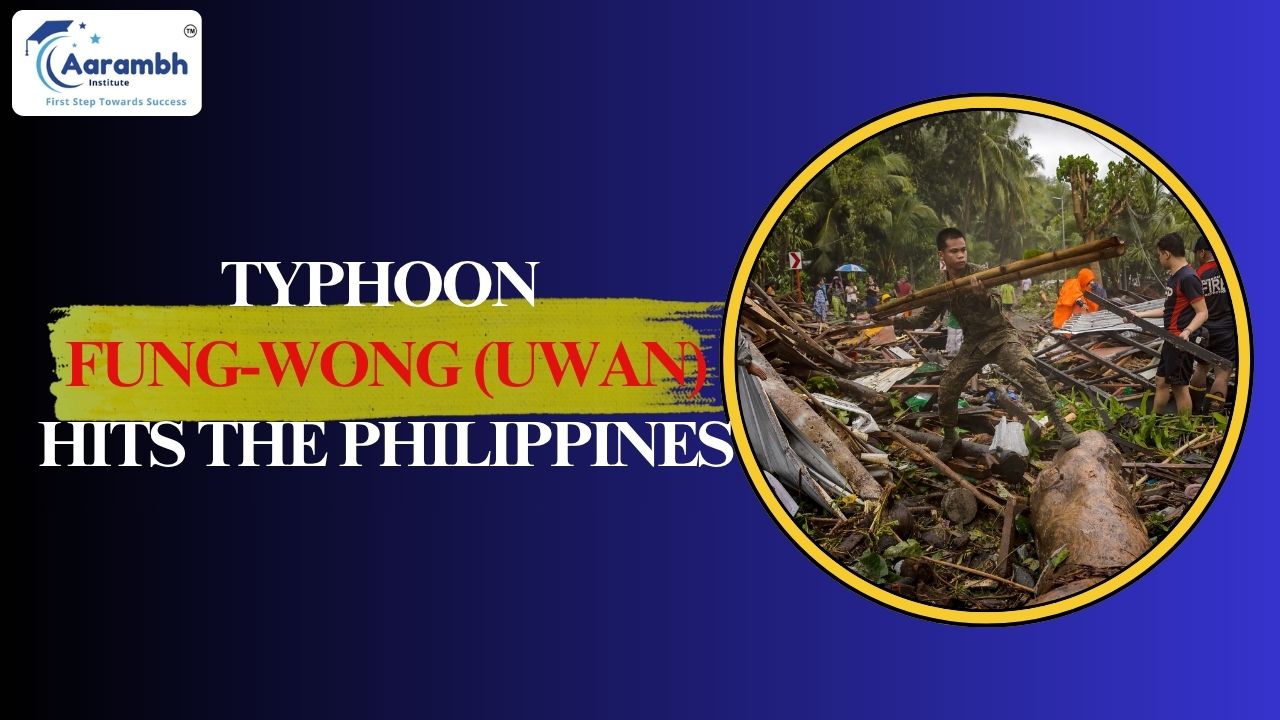
Typhoon Fung-wong (local name: Uwan) made landfall in Aurora province, northern Luzon, Philippines, with sustained winds of 185 km/h and gusts up to 230 km/h.
The typhoon caused heavy rainfall, flash floods, and widespread power outages across multiple provinces before weakening over La Union.
It is one of the strongest storms to hit the country in 2025.
Geographical and Meteorological Aspects
The Philippine Atmospheric, Geophysical and Astronomical Services Administration (PAGASA) confirmed that the typhoon rapidly intensified while approaching the eastern coast.
The Philippines lies in the Pacific typhoon belt, making it one of the most disaster-prone regions in the world.
An average of 20 tropical cyclones strike the country every year.
The warming of ocean temperatures due to climate change has been linked to the increasing frequency and intensity of such storms.
Impact and Damages
Heavy flooding and landslides occurred in Aurora, Nueva Ecija, and Benguet provinces.
Strong winds uprooted trees, destroyed homes, and damaged power and communication lines.
The National Disaster Risk Reduction and Management Council (NDRRMC) reported casualties and missing persons, though assessments are still ongoing.
Thousands of residents were evacuated from coastal and low-lying areas as a precautionary measure.
Flights, classes, and sea travel were suspended across Luzon to ensure public safety.
Relief and Response Measures
The Philippine government launched emergency relief operations with assistance from the military and local authorities.
President Ferdinand Marcos Jr. held an emergency meeting with the National Disaster Council to coordinate response actions.
The Department of Social Welfare and Development (DSWD) provided emergency funds, relief goods, and aid to evacuation centers.
PAGASA downgraded the system to a tropical storm as it moved northwest toward the West Philippine Sea but maintained warnings for flash floods and landslides.
Context – Back-to-Back Typhoon Events
Typhoon Fung-wong struck just weeks after Typhoon Kalmaegi, which caused over 200 deaths and led to a state of calamity in several regions.
The back-to-back disasters have highlighted the Philippines’ vulnerability and limited disaster recovery capacity.
Experts warn that repeated cyclones could strain local resources, delay reconstruction, and increase the vulnerability of affected populations.
Environmental and Policy Relevance (UPSC Perspective)
Demonstrates the link between climate change and extreme weather events.
Emphasizes the importance of disaster risk reduction (DRR) and climate adaptation strategies.
Highlights the need for regional cooperation in disaster management within the Asia-Pacific region.