
AARAMBH INSTITUTE • CURRENT AFFAIRS
Dandi March
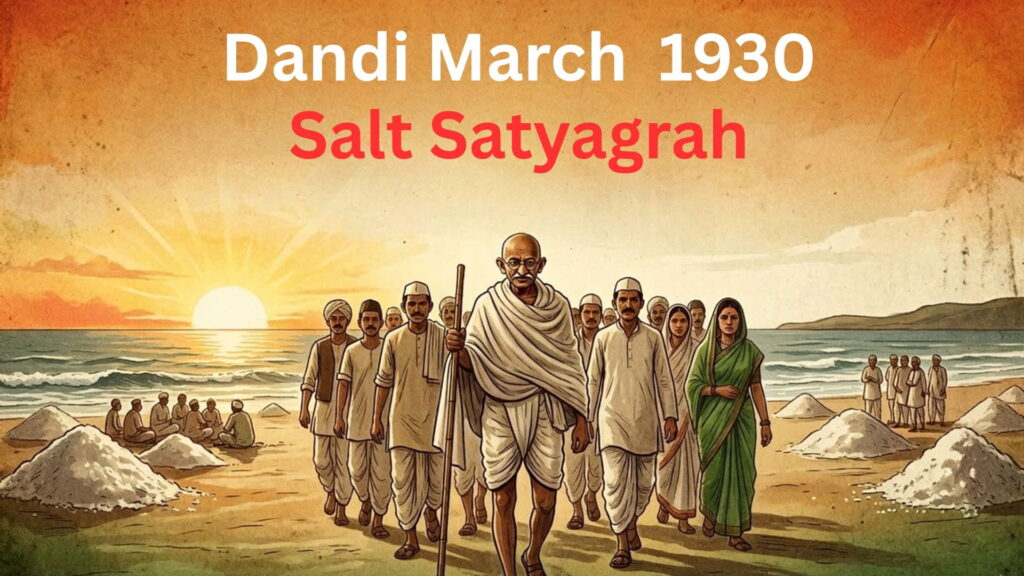
Table of Contents
In News
- The Vice President of India paid tribute to the freedom fighters and said that the spirit of self-reliance of the Dandi March continues to inspire India even today in becoming a self-reliant and developed nation.
Introduction
- The Dandi March carried out in 1930 under the leadership of Mahatma Gandhi was a historic event in the Indian freedom movement.
- This movement was started in protest against the salt tax and salt monopoly of the British government.
Timeline
- The Dandi Yatra began on 12 March 1930 from Sabarmati Ashram located in Gujarat and ended on 6 April 1930 at Dandi village.
- In the journey of about 240 miles, initially 78 followers accompanied Gandhi Ji, which later turned into a massive mass movement.
Main Objective
- The main objective of this movement was to oppose the salt tax imposed by the British government and the monopoly over salt production.
- Salt was a commodity used by all sections of society, therefore Gandhi Ji made it the symbol of the movement.
Violation of Salt Law
- On 6 April 1930, Gandhi Ji violated the British salt law by picking up natural salt from the seashore of Dandi.
- After this incident, the Civil Disobedience Movement intensified across the country.
Movement in Other Regions
- C. Rajagopalachari broke the salt law at Vedaranyam (Madras Presidency).
- K. Kelappan organized a salt march in the Malabar region.
Repression and Arrests
- The British government carried out widespread arrests to suppress the movement.
- On 5 May 1930, Mahatma Gandhi was arrested.
- After this, Sarojini Naidu led a peaceful protest at the Dharasana Salt Works.
Historical Significance of Dandi March
- The Dandi March brought international recognition to the Indian freedom movement.
- This movement inspired many non-violent movements across the world, including the civil rights movement of Martin Luther King Jr.