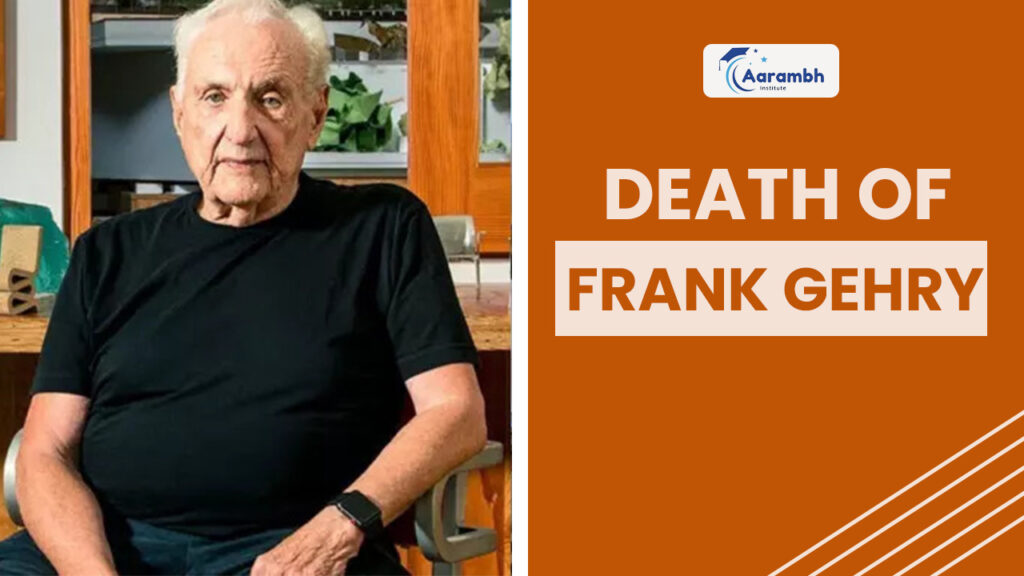
Frank Gehry, one of the most prestigious and innovative architects of the modern era, passed away at the age of 96 at his home in Santa Monica due to a respiratory illness.
He gave a new direction to global architecture and gained worldwide fame for his bold, sculpture-like forms and innovative designs.
Gehry received the Pritzker Prize, one of the highest honors in architecture, which is often called the “Nobel Prize of Architecture.”
He was honored with the RIBA Gold Medal and several lifetime achievement awards by various international institutions.
His creations were appreciated for their originality, American spirit of innovation, and complex structural experimentation.
Gehry’s design approach was inspired by modern pop art, which made his buildings unconventional and visually striking.
His major works include the Guggenheim Museum Bilbao, Walt Disney Concert Hall, Los Angeles, and the DZ Bank Building, Berlin.
These buildings challenged traditional architectural norms and established the use of new engineering techniques and digital modeling.
Gehry completed influential projects even after the age of 80, including the IAC Building, New York (2007) and New York By Gehry (2011).
His 76-storey New York By Gehry tower became one of the tallest residential buildings in the world and gave a new shape to Lower Manhattan’s skyline.
He taught at prestigious universities such as USC, Yale, and Columbia, thereby influencing a new generation of architects.
Several criticisms were also made regarding Gehry’s unconventional and bold style, with some critics describing his buildings as excessively grand or tourism-oriented.
The Eisenhower Memorial and various corporate expansion projects were among the major controversial aspects of his career.
Despite criticism, his creative freedom, risk-taking ability, and revolutionary thinking made him the most influential name in modern architecture.
His life’s work remains a lasting symbol of imagination, innovation, and artistic courage in global architecture.